Help
Shipping questions
Shipping is where the remaining money is decided, and where the decisions are least reversible. Two mechanics explain most of the confusion: goods restrictions shorten your options, and the price you pay first is a deposit rather than a bill.
Restrictions come first, price comes second
People approach the shipping screen looking for the cheapest line. The more useful first question is which lines will carry what you bought at all.
Batteries and liquids are the two that catch most orders. A single pair of wireless headphones or one bottle of perfume can dictate how an entire consolidated box travels, because the restriction applies to the parcel rather than to the item.
This is a strong argument for deciding the route before you buy. Once goods are sitting in the warehouse your options are whatever they are.
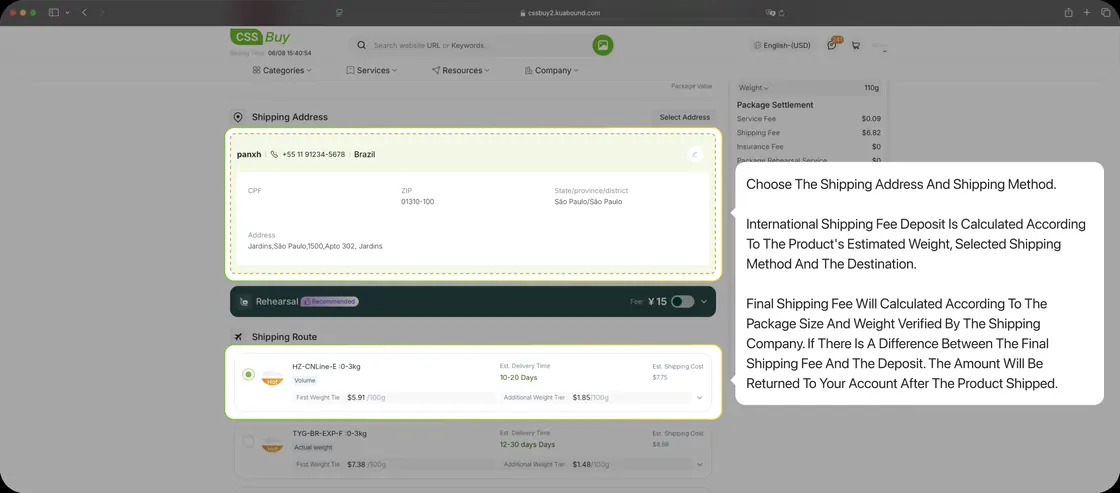
The deposit, and why it reconciles
What you pay at this step is calculated from estimated weight, your chosen line and your destination. The carrier then weighs and measures the actual box. Where the two differ, CSSBuy returns the difference to your account balance after dispatch.
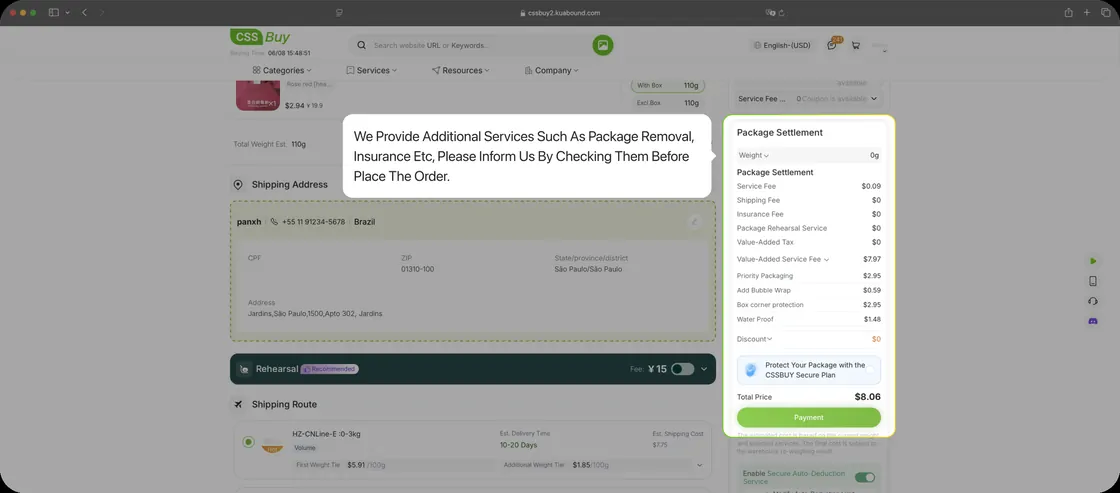
This is also where packaging choices bite. Keeping shoe boxes intact protects the item and inflates the volume you are billed for. Removing them saves money and loses the box. Which matters more depends on whether you are wearing the thing or keeping it.
Example routes
Three routes CSSBuy publishes, and how to read them
These are the lines CSSBuy displays on its own home page, read on 3 September 2026. They are a sample rather than the full list, and they are here to show you what a route quote is made of. For a number that applies to your parcel, use the official calculator.
| Route | Destination | First weight | Continued weight | Transit | Weight basis |
|---|---|---|---|---|---|
| TYG-EU-Tariffless Express | Germany | ¥85 / 500g | ¥45 / 500g | 10 days | Volumetric ratio 9000 |
| HZ-EUB | Brazil | ¥40 / 100g | ¥13 / 100g | 20 days | Actual weight |
| CSS-PL-Tariffless-F | Poland | ¥48 / 200g | ¥10 / 100g | 15 days | Volumetric ratio 8000 |
Source: the shipping panel on cssbuy.com, read 3 September 2026. Prices are the yuan figures CSSBuy publishes; the site converts them to your display currency at whatever rate applies when you look. Rates and transit times change without notice, so treat this table as an illustration of structure rather than a quote.
What the four columns actually mean
First weight
A minimum charge covering the opening block of weight. It is why one very light parcel is rarely cheap, and why consolidating is worth the wait: you pay this once per box, not once per item.
Continued weight
What each additional block costs after the first. Note the blocks differ by route: 500g on the German line, 100g on the Brazilian one. A route with a small block is finer grained and usually kinder to odd weights.
Transit time
The carrier's own estimate, and it excludes the time your goods sit in the warehouse waiting for you to ship them. It also excludes customs holds, which nobody can predict.
Weight basis
The one people miss. Actual weight bills what the scale says. Volumetric ratio bills whichever is greater, real weight or length×width×height divided by that number. A bulky, light parcel costs far more on a volumetric route.
Why there is no United States row. CSSBuy does not publish a US line in that public panel, and we are not going to invent one. US routes exist inside the calculator, which needs a CSSBuy account to run. Same for any destination not listed above.
Getting a number for your own parcel
The official calculator takes a destination, a weight, the parcel dimensions and any attributes such as batteries or liquids, then returns the routes that will accept it with a price for each. That last part is the reason to use it: it filters out lines that will refuse your goods before you get attached to a price.
It requires a CSSBuy account. Registration is free, and you will need one to order anyway, so doing it before you shop rather than after saves a step.
Two habits make the estimate more honest. Enter the packed dimensions rather than the bare item, because that is what gets billed on volumetric routes. And run it twice, once with packaging kept and once removed, to see what the shoe boxes are actually costing you.
Shipping
Six questions about getting it home
How do I choose between shipping lines?
Three variables move together: price, speed and what the line will accept. A cheap slow line and an expensive fast one to the same country are both legitimate choices. What should decide it is your goods, because restrictions remove options before price is even relevant. Compare on the official calculator for your actual destination.
What counts as restricted?
Most commonly batteries, liquids, powders and aerosols. Headphones, speakers and anything rechargeable fall into the battery category. Perfume falls into liquids. Rules differ by line and by destination country, so the same item can be fine on one route and refused on another. Check before buying rather than after.
Why is my light parcel expensive to ship?
Volumetric weight. Carriers bill on whichever is greater, actual weight or the space the box occupies. A puffer jacket or an intact shoe box is mostly air, and you pay for the air. Requesting packaging removal at the packing step is offered precisely for this.
Why did the final shipping cost differ from what I paid?
Because the first number is a deposit based on estimated weight, your line and your destination, while the final number comes from the carrier weighing and measuring the real box. CSSBuy returns the difference to your account balance after the parcel ships. It is designed to reconcile rather than to be exact up front.
Can I combine orders bought weeks apart?
Yes, and this is the main reason the warehouse exists. Items wait, then you select several and submit them as one shipment. You pay the expensive first weight charge once instead of once per parcel. The limit is the storage window: 90 days free from the In Warehouse status, extendable per order for a monthly fee.
Tracking has stopped updating. What now?
Wait, unless it has been substantially longer than the quoted transit time for that line. Customs clearance and carrier handovers routinely produce multi day silences. When it genuinely is overdue, raise it in the parcel's note thread where the history is attached. CSSBuy states plainly that it cannot control delays, confiscation, duties, damage or loss once a parcel is with a third party carrier.
Want the whole cost picture?
The fees page walks every point where money leaves your hands, in the order it happens.